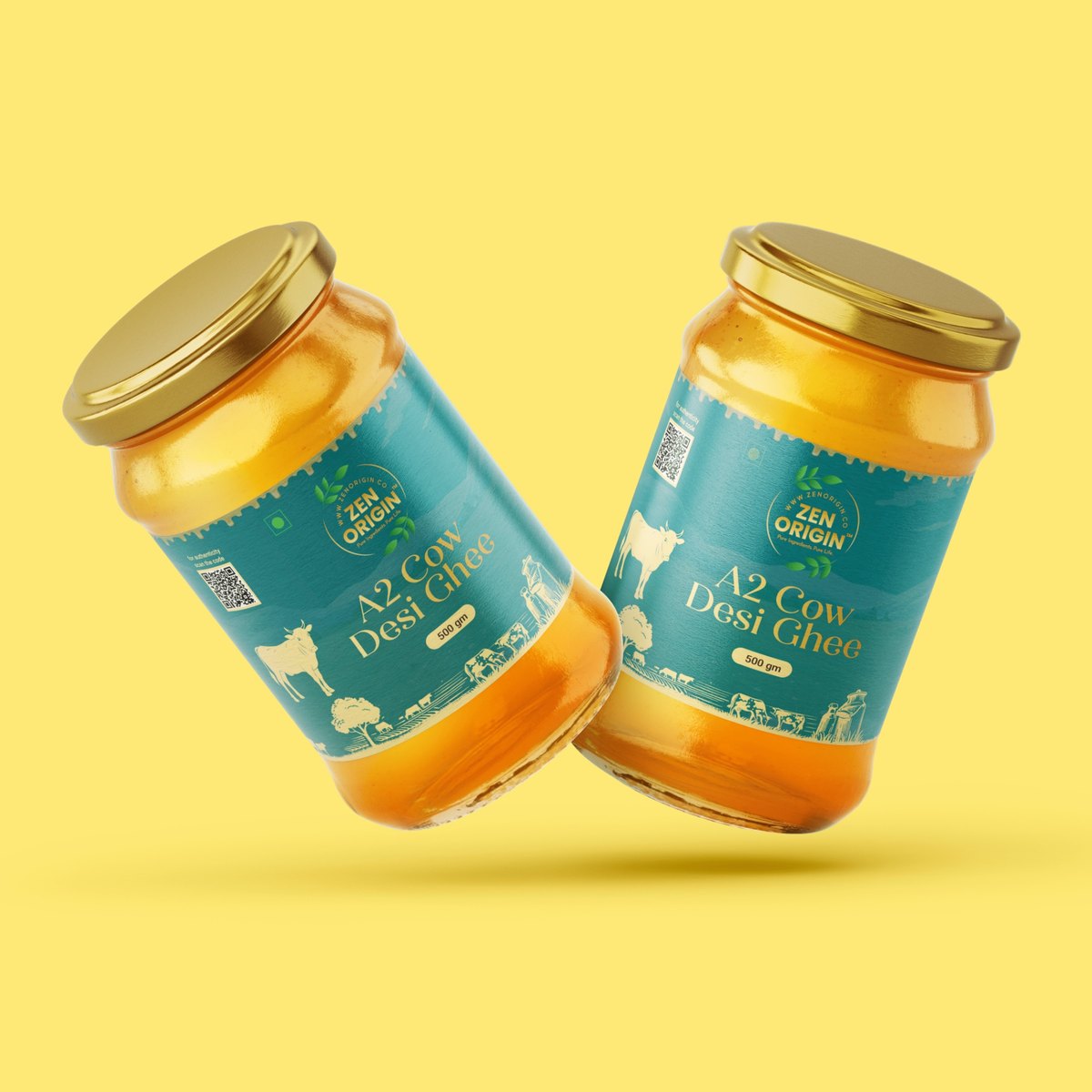

Walk down any grocery aisle and you will see “A2” on ghee jars, often at a premium. The term is real and the difference is real, but it is widely misunderstood. This guide explains what A2 means, what the evidence does and does not show, and what is worth paying attention to when you choose a ghee.
A1 and A2: a difference of one amino acid
Cow’s milk contains several proteins. Casein makes up about 80% of them, and one type, beta-casein, comes in two common variants. A1 and A2 beta-casein differ by a single amino acid in a chain of 209: at position 67, A2 has proline while A1 has histidine.
That small change matters during digestion. When A1 beta-casein is broken down, it can release a peptide called beta-casomorphin-7 (BCM-7); A2 beta-casein releases little or none. Indigenous Indian breeds such as Gir, Sahiwal and Red Sindhi produce milk with A2 beta-casein, while many high-yield crossbred and European cattle produce a mix of A1 and A2.
What the research says about A2 milk
Some studies suggest that people who feel discomfort after drinking ordinary milk may tolerate A2 milk better. Broader claims, that A1 milk causes diabetes, heart disease or other conditions, are not supported. A 2019 systematic review in Nutrition Reviews and the European Food Safety Authority both concluded that the evidence for such harms is insufficient. A 2023 review of A2 milk research similarly describes the evidence for health benefits as limited.
Why this matters less for ghee than for milk
Here is the part labels rarely mention. Ghee is clarified milk fat. When butter is slow-cooked, the milk solids, which hold the protein, separate out and are strained away. FSSAI requires ghee to be at least 99.5% milk fat, so very little protein of any kind remains.
What A2 on a ghee label is really telling you
That does not make the label meaningless. When honestly used, “A2 cow ghee” tells you the ghee comes from indigenous desi breeds rather than crossbred cattle. That often goes with other things that do shape the ghee in your jar:
- The herd and its feed. Free-grazing animals on pasture produce milk fat with a different flavour and colour from stall-fed animals on concentrate.
- The method. Traditional ghee is made by culturing milk into curd, churning it into butter (the bilona method) and slow-cooking the butter. Many industrial ghees are made directly from cream. The cultured route gives the nutty, granular ghee many Indian kitchens grew up with.
- The batch size. Small batches cooked slowly caramelise the milk solids evenly, which is where much of ghee’s aroma comes from.
How to choose a good ghee
- Check the source: which breed, and how the animals are kept.
- Check the method: cultured and churned, or direct-from-cream.
- Check the texture and aroma: good slow-cooked ghee is granular at room temperature and smells nutty and rich, never rancid or oily.
- Check the lab report: this is the real proof of purity. FSSAI sets limits for the Butyro-refractometer reading and the Reichert-Meissl value that reveal vegetable oils and other fats. We explain both in how to tell if ghee is pure.
How our ghee is made
Our A2 Cow Desi Ghee starts with milk from free-grazing desi cows. The milk is cultured into curd and churned for butter, and the butter is slow-cooked in small batches until the solids caramelise and the ghee turns clear and golden. Nothing is added: no hormones in the herd, no preservatives in the jar. Each batch is tested by an accredited laboratory, and the full report is linked on the product page.